


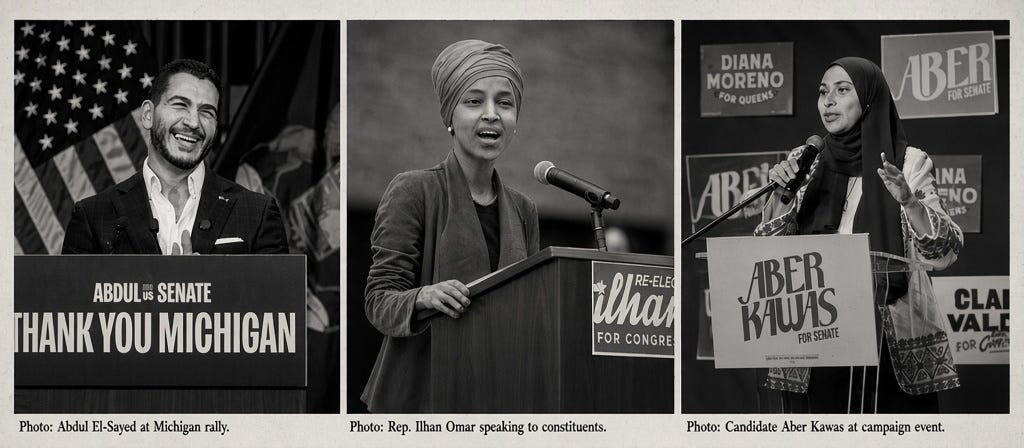
“Up until right about now, you might have noticed I always say ‘inshallah,’ or ‘God willing,’ whenever the outcome of this race was mentioned. But today, tonight, we can turn that ‘inshallah’ into ‘alhamdulillah.’ For the right-wing ops, that just means ‘praise be to God,’ OK?”
That was Abdul El-Sayed on Tuesday night in Detroit, after he beat Mike Rogers to become Michigan’s next U.S. senator and the first Muslim senator in American history. He went on to tell the crowd that “the bad guys lost.”
Let’s be honest. My first reaction wasn’t prayer. It was a tightening in my chest. If you love Jesus and this country, you may have felt it too.
He wasn’t the only one. In Minnesota, Ilhan Omar won her fifth term and spoke to supporters in Somali at Karmel Mall. In New York, Aber Kawas won State Senate District 12, becoming the first Palestinian American elected to the state legislature. Her victory post carried a Palestinian flag, not an American one. In a 2017 podcast she described capitalism, racism, white supremacy, and Islamophobia as “a long trajectory,” adding, “we’re just seeing the manifestations of that continuation with 9/11.” (She has since said those comments were cherry-picked).
Overseas, some people cheered. A Muslim Brotherhood-linked outlet celebrated El-Sayed’s primary win with a headline about conquering “the Zionists.” After the midterms, Iran’s Supreme Leader said the process of America’s collapse has accelerated, called us the Great Satan, and declared our decline irreversible.

I’m not listing these things to stir you up. I’m naming them because I think a lot of believers woke up Wednesday with an ache they couldn’t quite put into words.
Here it is. Some of the people who now hold real power don’t share our convictions about Israel, about religious liberty, about marriage and sexuality, or about what it means to be American. Some may actively oppose what we believe. That matters, and Scripture won’t let us pretend that truth and morality don’t count.
But here’s the thing. God’s people have been somewhere much harder than this.
Think about Shadrach, Meshach, and Abednego. They were exiles, carried off to Babylon, renamed, retrained, and set to work serving a foreign king. Nebuchadnezzar’s empire stood against nearly everything they believed. Then in Daniel 3 he raised a golden image ninety feet tall and ordered every official to bow down. The furnace wasn’t a figure of speech. It was real, and it was heated seven times hotter.
Imagine how those three young men felt. Their leaders weren’t just mistaken. They were opposed to the living God. And yet look at what the three didn’t do. They didn’t plot against the king, and they didn’t curse him. They kept doing their jobs well. They spoke to him with respect: “O Nebuchadnezzar.” But when he crossed the line, they refused without flinching: “…our God whom we serve is able to deliver us from the burning fiery furnace…But if not, be it known to you, O king, that we will not serve your gods or worship the golden image that you have set up” (Daniel 3:17-18).
They had their convictions straight, and they had their King straight. Nebuchadnezzar was powerful, but he wasn’t ultimate. He opposed them, but he wasn’t the Enemy. They knew the real battle was spiritual, and that God was still on His throne beyond Babylon.
That’s what I was trying to say in my last piece, “The Morning After: Jesus Is Still King.” The book of Daniel keeps repeating it: earthly power is temporary. Kingdoms rise and fall. “He removes kings, and sets up kings” (Daniel 2:21). Babylon won plenty of nights, but now Babylon…is gone.
So what do we do now?
We pray for them.
Paul writes, “First of all, then, I urge that supplications, prayers, intercessions, and thanksgivings be made for all people, for kings and all who are in high positions, that we may lead a peaceful and quiet life, godly and dignified in every way.” (1 Timothy 2:1–2). Paul wrote that under Nero. He didn’t say to pray for the rulers you voted for. He said all of them.
Jesus goes further: “But I say to you, Love your enemies and pray for those who persecute you” (Matthew 5:44). Paul echoes Him: “Bless, and curse not” (Romans 12:14).
I know that can feel nearly impossible. But praying for someone isn’t the same as agreeing with them. You can pray for Senator-elect El-Sayed, Representative Omar, and Senator-elect Kawas by name, and still hold every conviction you held on Monday.
Pray that God gives them wisdom. Pray that truth wins out in their offices and in their hearts. Pray for their families and their safety. Pray for their good and for the good of the nation they now serve. Pray that they come to know the One who is King over every king. And pray for us, that we would be as faithful in our Babylon as those three young men were in theirs.
These officials are not the enemy. They are people made in the image of God, and Christ died for them just as He died for you and me.
Speaking the truth and praying for those who oppose it aren’t opposites. They belong together. Silence about either one would be its own kind of answer.