


I’ve watched a lot of Russell Hunter’s videos.
If you’re unfamiliar with him, he’s often on a college campus, standing in an open area, talking with students about abortion and Jesus. He asks questions. He challenges their thinking. And he stays in the conversation, even when things get uncomfortable.
What I’ve noticed is that people don’t always appreciate what he has to say. Sometimes they get angry. Sometimes they walk away. And sometimes they simply want him gone.
This week, that’s exactly what happened. Except this time, it ended in handcuffs.
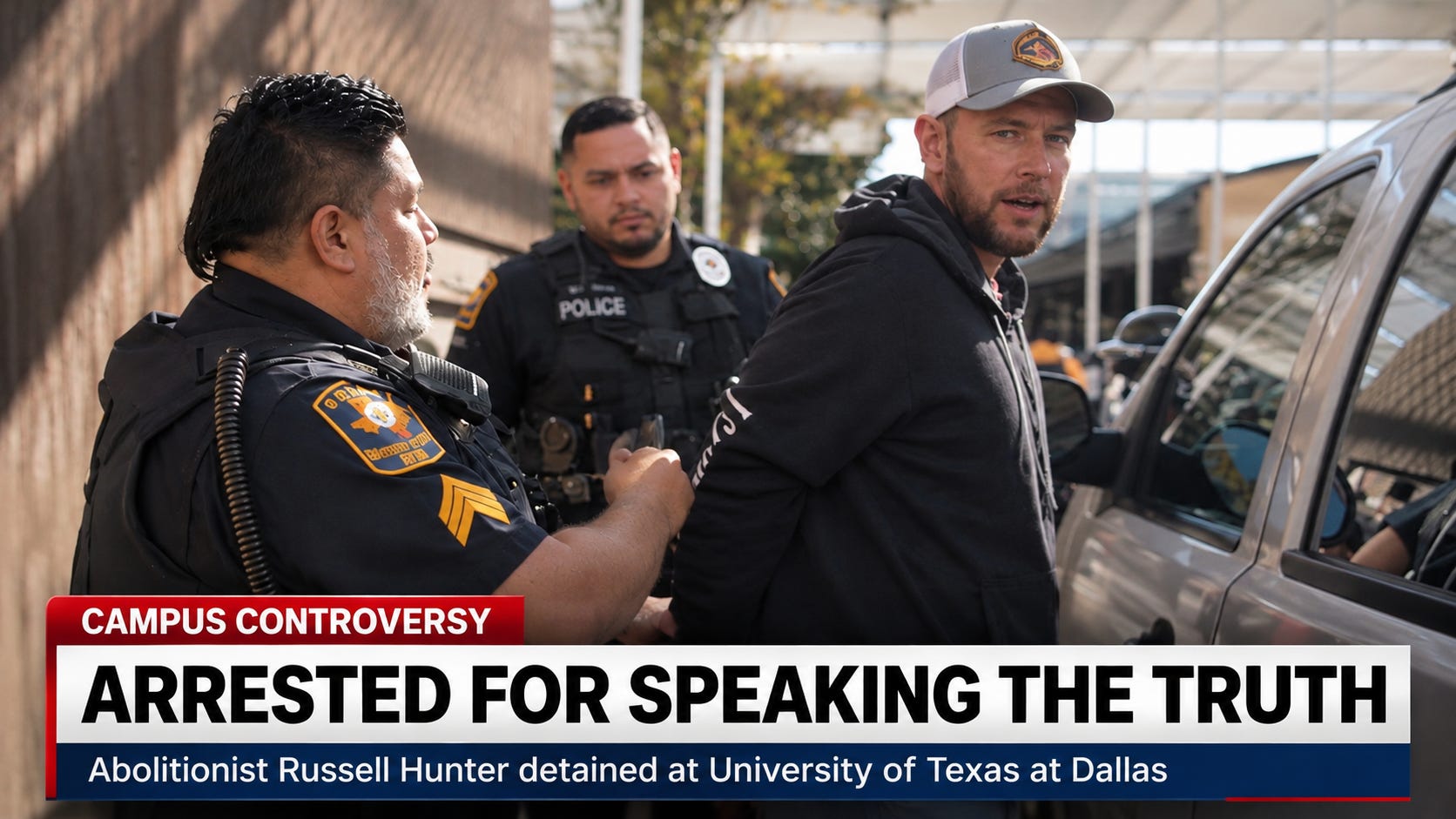
On Wednesday, November 18, T. Russell Hunter, founder of Abolitionists Rising, was arrested at the University of Texas at Dallas.
According to his attorney, CJ Grisham, Hunter had been speaking with students for more than two hours in an open campus plaza. He wasn’t using a bullhorn or blocking sidewalks. He had a sign, a couple of cameras, and a willingness to engage students in conversation.
Then a university administrator approached and demanded that he leave. Apparently, some students had complained about his message. Interestingly, others reportedly told the administrator they wanted him to stay.
The police were called anyway.
According to Hunter’s attorney, when Hunter asked what law or university policy he was violating, he received no explanation. Within minutes, he was handcuffed and arrested for criminal trespass.
Hunter spent approximately twenty-four hours in jail before being released on bond. His attorney disputes the legality of the arrest, and the organization intends to challenge it.
Now, there may be legal questions about university policies governing outside speakers. Those questions deserve a fair hearing, and the full circumstances should be examined. But there’s something deeply troubling about the possibility that a man was arrested simply because people didn’t like what he was saying.
And that brings me to something I think is even more important.
Russell Hunter doesn’t typically describe himself as simply pro-life. He’s an abolitionist.
There’s an important distinction.
Much of the pro-life movement has focused on incremental legislation. Heartbeat bills, restrictions after certain stages of pregnancy, and other measures intended to reduce the number of abortions.
Abolitionists take a different approach. They argue that if the child in the womb is truly a human being, created in the image of God, then the goal cannot simply be regulating abortion. It must be ending it.
In other words, they aren’t interested in making abortion more difficult. They want it abolished.
There are legitimate disagreements among Christians about the best legislative strategy to protect unborn children. But I think Hunter’s position raises an important question: If we genuinely believe these are human lives, shouldn’t our ultimate goal be their protection?
And that’s where my mind goes back more than two hundred years.
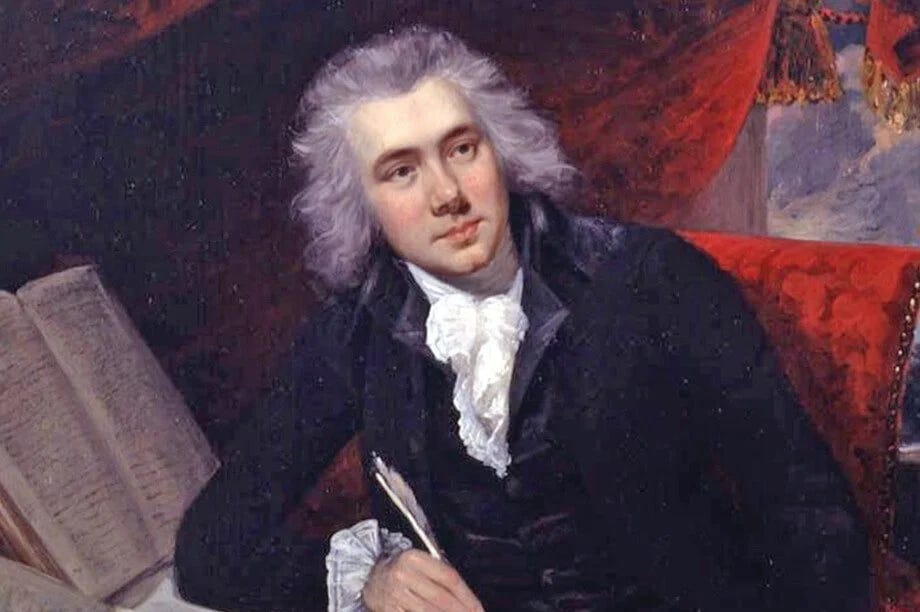
In 1787, a young British politician named William Wilberforce took up a cause that would consume much of his life: ending the slave trade.
At the time, slavery was deeply embedded in the British economy. Powerful people benefited from it. Many considered it necessary. Others simply preferred not to think about it.
Wilberforce refused to look away.
Motivated by his Christian faith and his conviction that every human being possesses God-given dignity, he began challenging a system that much of his country had learned to accept.
In a speech before Parliament in 1789, he declared:
“We can no longer plead ignorance, we cannot evade it.”
That statement has always struck me.
Wilberforce understood that once a moral evil is exposed, we have a responsibility to respond. We can debate the details. We can disagree about the strategy. But we cannot pretend we don’t see what is happening.
For nearly twenty years, Wilberforce fought an uphill battle. His efforts were repeatedly defeated. He faced ridicule, opposition, and tremendous political pressure.
But he kept speaking.
In 1807, Britain finally abolished the slave trade. And in 1833, just days before Wilberforce died, Parliament took a decisive step toward abolishing slavery throughout most of the British Empire.
Today, we celebrate Wilberforce as a hero.
But I wonder how many people in his own day considered him a troublemaker.
How many wished he would stop bringing up such an uncomfortable subject? How many thought he was too extreme? How many believed he was making life unnecessarily difficult by challenging something society had already accepted?
There’s an important lesson here.
Sometimes the people history eventually celebrates are the very people their own generation wanted to silence.
I’m not suggesting that Russell Hunter is William Wilberforce. History will make its own judgments about individuals and their contributions. And the history of slavery and the modern abortion debate are not identical.
But I do see a common moral conviction: Human dignity should never depend on whether society finds it convenient to recognize it.
Now, back to that college campus in Texas.
Something about this incident particularly bothers me.
We’re talking about a public university. An institution supported by taxpayers, entrusted with educating the next generation of Americans.
Shouldn’t a university be one of the safest places in America to encounter an idea you disagree with?
I would think so.
Students should be challenged. They should hear arguments that make them uncomfortable. They should learn to examine evidence, defend their beliefs, and respectfully disagree with people who see the world differently.
That’s part of becoming an educated adult.
And let’s be clear. Free speech isn’t just for Christians or conservatives. I would defend the right of a progressive activist, an atheist, or someone advocating a position I strongly oppose to speak in a lawful public forum.
Because the moment we begin deciding whose ideas deserve protection based on whether we agree with them, we’ve misunderstood the entire purpose of the First Amendment.
Of course, universities can establish lawful, viewpoint-neutral rules about where and how outside speakers may gather. But those rules must be applied fairly, not selectively enforced because someone finds a particular message offensive.
A student who disagrees with Russell Hunter has every right to challenge him. Debate him. Ask difficult questions. Walk away.
But disagreement shouldn’t require a police officer.
A university that teaches students to silence opposing ideas instead of confronting them is failing to prepare them for the real world.
And frankly, that’s a frightening thought when you consider that these students will someday become our teachers, attorneys, business leaders, and elected officials.
As a pastor, I keep coming back to Proverbs 31:8–9:
“Open your mouth for the mute, for the rights of all who are destitute. Open your mouth, judge righteously, defend the rights of the poor and needy.”
That’s a pretty clear instruction.
Those who cannot defend themselves need someone willing to speak on their behalf.
And for those of us who believe that human life begins in the womb, that responsibility includes the unborn.
But there’s another biblical example worth remembering.
In Acts 4, Peter and John were ordered by the religious authorities to stop speaking about Jesus. Their response was remarkable:
“Whether it is right in the sight of God to listen to you rather than to God, you must judge, for we cannot but speak of what we have seen and heard.” (Acts 4:19–20)
They understood something we desperately need to remember.
Our responsibility to speak the truth doesn’t disappear when the truth becomes unpopular.
Now, that doesn’t give Christians permission to be cruel, arrogant, or unnecessarily confrontational. In fact, Scripture calls us to speak the truth in love. We should be the first people willing to listen, the first to demonstrate compassion, and the first to recognize the dignity of someone who disagrees with us.
But love and silence are not the same thing.
Sometimes love requires us to speak when remaining quiet would be much easier.
So I’m praying for Russell Hunter and his family. I’m praying that the legal questions surrounding his arrest are resolved justly. And I’m praying for those students, including the ones who disagreed with him.
But I’m also asking myself a question.
Am I willing to speak when speaking comes with a cost?
Not necessarily on a college campus with a sign in my hand. Maybe it’s around the dinner table. Maybe it’s in a conversation with a friend. Maybe it’s standing up for someone who cannot stand up for themselves.
William Wilberforce didn’t change history by remaining silent. He changed it because he was convinced that something was terribly wrong, and he refused to look away.
Perhaps that’s the challenge for us today.
We don’t have to be loud. We don’t have to be angry. And we certainly don’t have to win every argument.
But we do have to be willing to speak.